The Eckstein School (1930s)
The Thirties was a troubling decade. During the early years the country struggled with the fallout from the 1929 stock market crash. The economy plunged into deep depression leaving many jobless, and hungry. Towards the end of the decade the Second World War erupted across Europe. Although America was not yet involved in the fighting, it was still an alarming time.
INSIDE THE CLASSROOM
Samuel Engle Burr became Superintendent of Glendale Schools in August 1930. He remained in Glendale until Jul 1933. He was an exponent of the activity method of instruction. He believed that children “learnt by doing.” In a book describing his teaching method and the results of his work in Glendale he included the following description of the children who attended Eckstein School.
“Among the Negroes, none of the children had all the advantages which many of the white children had but there were a few who came from comfortable homes and who did profit by many advantages. During the entire time covered by this study, there were in Glendale many Negro children whose parents were poor, unschooled, physically deficient, and mentally retarded. On the whole, however, the Negro people were industrious, ambitious, well behaved, keenly interested in life, devoted to their children, to their school, and to their churches, and highly appreciative of any help that was given to them towards an improvement of their condition.”
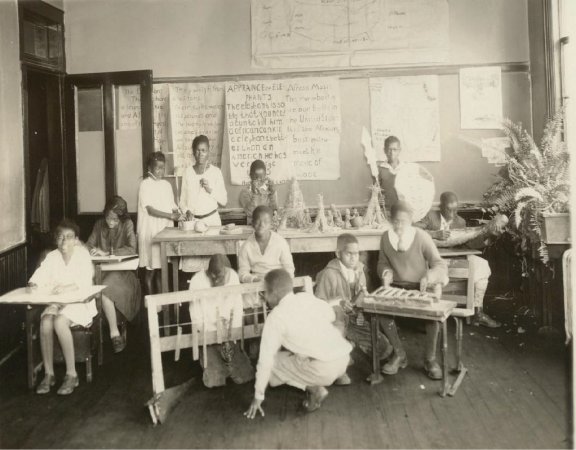
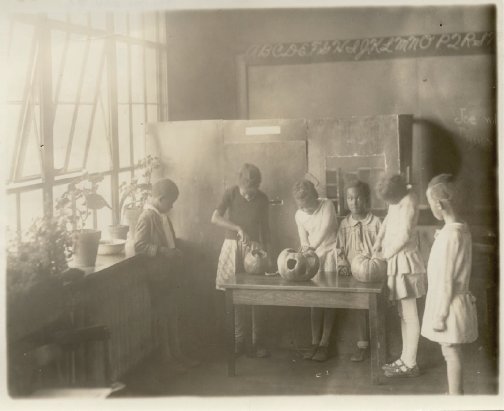
Under his direction children no longer sat at their desks to learn. Classrooms became hives of activities as children explored topics through project work.
PHOTOGRAPHS OF STUDENTS AT WORK ON THEIR PROJECTS.
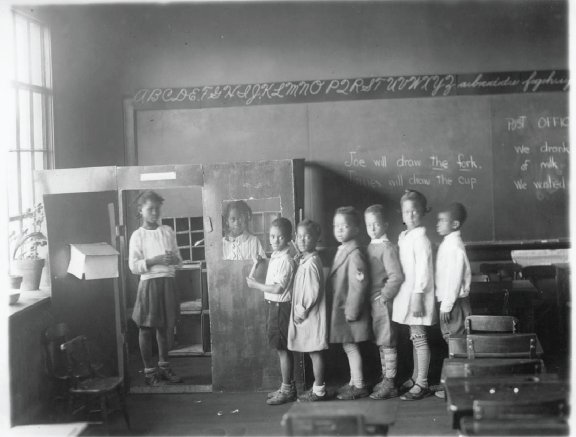
The Farm Project
We drink milk in our room.
We drink milk every morning.
We drink a half pint of milk every morning.
Eckstein Primary Group, 1931-32
The Horse
The horse ran away
One summer day
He didn’t like work
And he wanted to play
And so he ran far, far away.
First Grade Group, Eckstein, 1931-32
Cow and horse
Sheep and pig
All live on the farm
So big
First Grade Group, Eckstein, 1931-32
Miss Richardson’s 5th and 6th grade students studied the Negroes of Africa in the early 1930s. An African village with grass huts transformed the classroom. Students constructed various tools, utensils, and instruments that were used by villagers. The most popular included tom-toms, drums, marimbas, and suspended sticks.